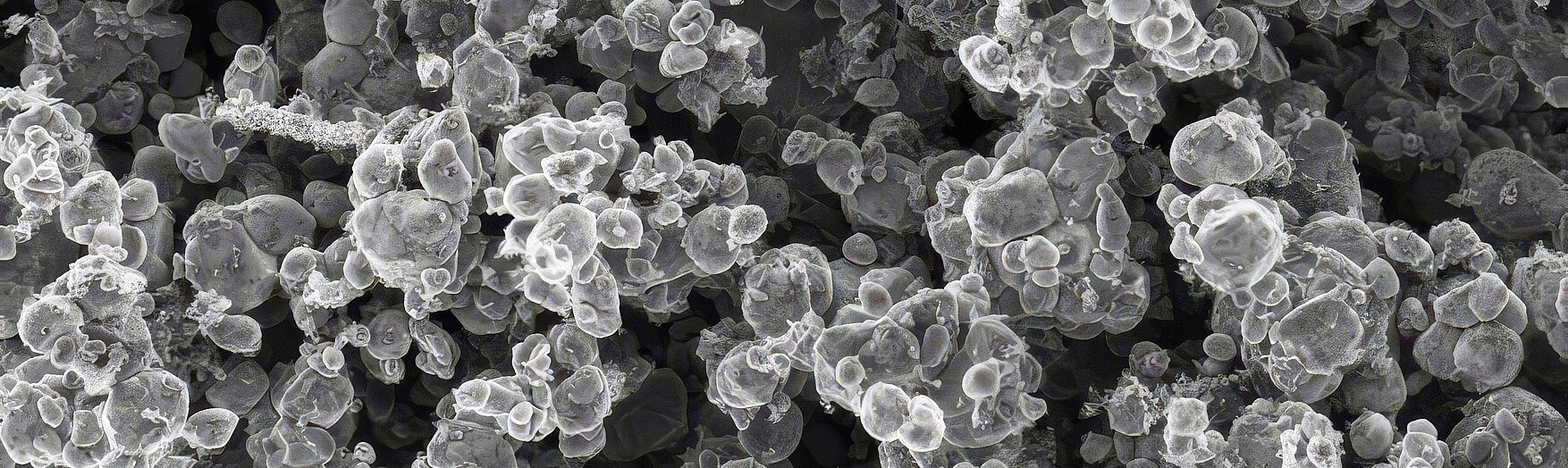
Lithium Iron Phosphate IBUvolt® LFP200
LFP Cathode Material for Cell Manufacturers
IBUvolt® LFP200 is a lithium iron phosphate cathode material (LFP, LiFePO₄) specifically developed to meet the requirements of industrial cell manufacturers. The focus is on stable mass-production processability, high energy density, and excellent cycle life for lithium-ion cells—particularly for automotive and stationary storage applications.
Technologically, LFP200 is based on the established IBUvolt® LFP402 platform and has been further developed for modern production environments. Adjustments to particle morphology, conductivity, and process windows enable cell manufacturers to optimize their existing electrode and cell designs with minimal adaptation effort, without sacrificing the proven properties of the original generation.
Advantages of IBUvolt® LFP200 for cell manufacturing:
- Advanced LFP cathode material based on an industrially proven platform
- Designed for high cycle stability and consistent performance over the entire service life
- Optimized for NMP/PVDF-based electrode coating processes
- Good process stability in existing coating, drying, and calendering lines
- Suitable for automotive cells, industrial storage systems, and home storage
LFP Material Development tailored to Cell Designs and Process Conditions
IBUvolt® LFP200 was developed in close collaboration with cell manufacturers. Based on customer projects and laboratory/pilot data, the material parameters were defined to address typical process windows in electrode manufacturing—from slurry viscosity and coating quality to compaction and electrical performance.
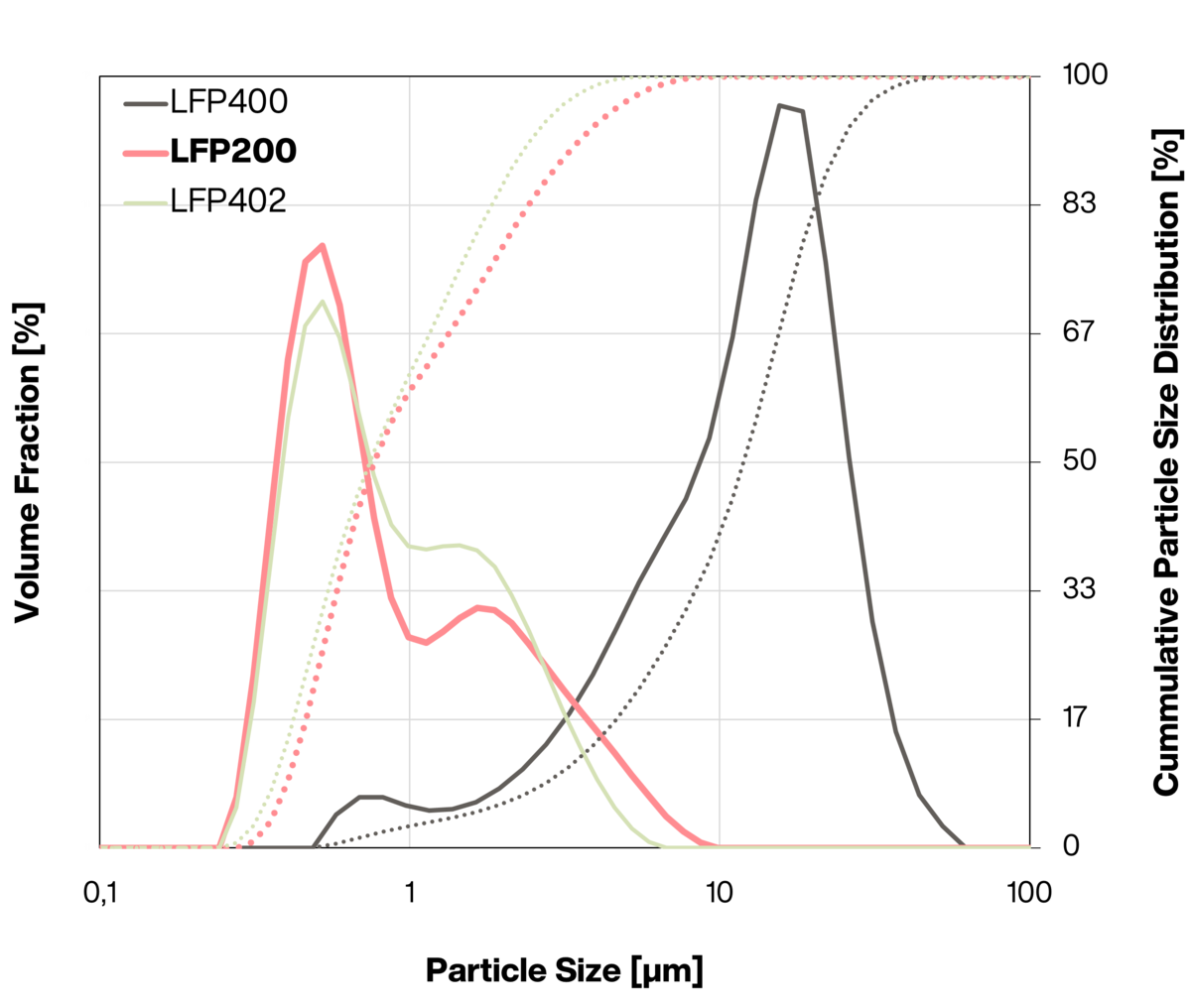
Particle characteristics: optimized particle size distribution and morphology to ensure homogeneous slurry behavior
Process compatibility: suitable for high-speed coating, common drying profiles, and standard calendering conditions
Design flexibility: supports different electrode loads and coating thicknesses for various cell designs
Cell manufacturers thus benefit from an LFP material that can be used for both existing cell platforms and new generations of LFP cells.
| Parameter | IBU Volt® LFP 402 |
|---|---|
| PSD [µm] (d10/d50/d90) | 0.5 / 1.3 / ≤ 8.0 |
| Power Density [g/cm3] (3T pressure) | > 2.5 |
| Energy Density [Wh/l] (Cathode, 97% avtive material, 0.1C) | > 1200 |
| Cycle life (2C/2C, 10-90% SOC, 25 °C) | > 3000 |
IBUvolt® LFP200 has been optimized for use in NMP/PVDF-based coating processes—the established standard in industrial electrode production.
Process-relevant properties:
- Good dispersibility and reproducible slurry stability
- Homogeneous coatings with high active material loading
- Controllable compaction behavior in the calender to achieve the desired electrode porosity
- Reliable bonding to aluminum current collectors and good mechanical stability of the electrode
As a result, LFP200 supports robust, scalable electrode manufacturing—from pilot lines to fully automated gigafactories.
Electrochemical Performance for advanced Cell Designs
IBUvolt® LFP200 is designed to deliver a combination of safety, cycle stability, and performance—key criteria for cell manufacturers in the automotive and stationary storage industries.
- High specific capacity combined with good energy density at the cell level
- Excellent cycle stability over many thousands of charge/discharge cycles
- Stable performance at practical charge and discharge rates
- High safety due to the intrinsically stable LFP chemistry
The fine-tuning of the conductive coating and carbon content is designed to ensure reliable electrical conductivity within the electrode assembly. This allows for stable cell parameters even at high C-rates—a significant advantage for fast-charging and fleet applications.

Production and Quality – Reliable LFP Material for Series Production
Like all IBUvolt® LFP cathode materials, IBUvolt® LFP200 is manufactured using an energy-efficient, low-emission process. The multi-step manufacturing approach—which includes aqueous raw material mixing, spray drying, calcination in a rotary kiln, and controlled deagglomeration—ensures a high degree of reproducibility.
For cell manufacturers, this means:
- consistent batch-to-batch quality,
- defined particle size distributions,
- stable electrochemical characteristics, and
- a reliable basis for scalable cell production